Friday, September 28, 2018

American Indian Heritage Day


The Last Friday in September is American Indian Heritage Day.  This is a day to recognize and celebrate the Native American tribes who contributed to the myths, legends and culture of Texas.  Texas even takes its name from the Caddo word for friend, which is why Texas is sometimes called the Friendship State.  The Caddo were an advanced tribe that settled along the Red River.  They were skilled hunters, traders and artisans, they also practice advance agriculture.  The Caddo could also be fierce warriors.  The Caddo had complex political and social structure and in the 17th and 18th Century they facilitated the movement of goods and information between the Europeans and other native american tribes.  Unfortunately the Caddo, like many other native peoples, would fall victim to European diseases, and an estimated 95% if the population would die from cholera and smallpox between 1691 and 1816.

The Lipan and Mescalero Apache are a second group of important Native Americans that called Texas home.  These nomadic hunters and traders ranged across South Texas, the Rio Grande Valley all the way to the pan handle.  The Apache often allied themselves with the Spanish who offered some protection from the Comanche.  Some Apache tried to settle in the Spanish Missions to protect themselves from enemies, however the labor demands of agriculture and the Spanish Friars trying to make them into "Good Catholics" wore on the Apache and they eventually returned to their old way of life.

The Comanche ranged from central Texas all the way through the Great Plains till they hit the mountains in the west.  They are perhaps one of the greatest mounted warriors of all time, capable of riding great distances in a short period of time and launching powerful hit and run attacks all the way to the Gulf of Mexico.  It will not be until after the Civil War that the United States will bring Comanche territory under its control.

Friday, September 21, 2018

Legacy of the Founding Documents and Ideals


During this freedom week I have written about Declaration of Independence and the U.S. Constitution, and the Bill of Rights.  These documents were a turning point in world history. At the time of their writing the European Powers had created a powerful European Hegemony over the rest of the world, based on military might.  At the same time Enlightenment thinkers were developing new ideas of freedom, about the role of government and it's relationship to it's citizens, and about the rights of women.  These two opposite forces saw a struggle emerge in Europe between traditional powers and new ideas.

In the United states this struggle resulted in the American Revolution and the creation of a new government based on the ideals of the Enlightenment.  This was not the fulfillment of the promises of the Enlightenment, but an important step along the road to achieving what European philosophers envisioned.

The most apparent failure of the Constitution to fulfill the  ideals of the Enlightenment was it's inclusion of slavery in the United States.  The idea that one man could own another was at odds with the idea that all men are created equal, a fact that was not lost on many of the founding fathers.  The abolitionist movement began long before the founding of the United States, and would take over 75 years, a civil war, the Emancipation Proclamation from Abraham Lincoln freeing slaves in the rebelling states, and finally an Amendment to the Constitution before slavery was ended in the United Stats with the ratification of the 13th Amendment.

Women were another group that were overlooked by the ideals of the founding documents.  While the Constitution did not bar women from voting and participating in government, it did not guarantee those rights.  The fight for women's right to vote was another long and hard fought journey to live up to the ideals our country was founded on.  While several western states allowed women to vote and hold office, it wasn't until after World War I that the 19th Amendment was passed guaranteeing women the right to vote.

The Declaration of Independence the U.S. Constitution, and the Bill of Rights did not instantly transform the United States into a Utopian society where everything is perfect.  These documents do, however, serve as the backbone of a society that is constantly striving to get better and live up to the ideals of the as laid out in these documents.  While it is important to acknowledge when we have fallen short of the ideals of these documents, it does not diminish the importance of these documents and the men who wrote them as guide as we constantly strive to insure the promise of these ideals are guaranteed for all groups and peoples.

Thursday, September 20, 2018

Ratifying the Constitution


On September 17th, 1787, the delegates to the Constitutional Convention finished their work, signed the document and sent it to Congress.  The first hurdle to ratification was getting passed Congress. the delegates had been tasked to revise the Articles of Confederation and had way over stepped their charge by creating a whole new government.  For two days Congress debated on whether to censure the delegates and throw out the new constitution or forward it on the the state legislatures for ratification. The decision was finally made to drop the issue with the delegates and on September 28th the Congress send the constitution to the states for ratification.  It would only take 9 states to ratify the new Constitution for to take effect.  Each state called a ratification convention to discuss the proposed constitution and new government.

The Constitutional convention had worked in secrete on the new constitution, so the ratification convention served not only as a forum for debate on the constitution but a platform to explain the provisions for the new government. The process also faced challenges from those who thought the process was illegal under the Articles of Confederation.  The New Constitution provided for citizen of each state to ratify at state conventions, however the Articles of Confederation could only be amended by unanimous approval from the state governments.  There were also claims that the new constitution was written by the elite for the elite and was an attempt to take power away from the states and into the hands of a few powerful men.  The lack of a Bill of Rights was also a mark against the new constitution.

Delaware was the first state to ratify the Constitution on December 7th, 1787.  The next states to ratify the Constitution were Pennsylvania, New Jersey, Georgia, and Connecticut.  When the first amendment was proposed securing the rights to freedom of speech, religion and press (Part of the Massachusetts Compromise) the states of Massachusetts, Maryland, South Carolina and finally New Hampshire pushing them over the 9 states required for the Constitution to go into effect.

Eventually all of the 13 original states would ratify the Constitution and join the United States of America.  The last to do so was Rhode Island, faced with the possibility of going it alone and being treated as a foreign power by the other states, they ratified the Constitution on May 29th, 1790 by only 2 votes.


Wednesday, September 19, 2018

The Bill of Rights


In the fight to ratify the Constitution of the United States, the largest overriding concern was with the protection of individual rights.  The people of the 13 colonies had just fought a long and hard war to secure their freedoms and rights, and were in no hurry to create a strong national government that could take those rights away.  In order to secure the passage of the Constitution 10 Amendments were proposed and eventually added.  These Amendments are known as the Bill of Rights


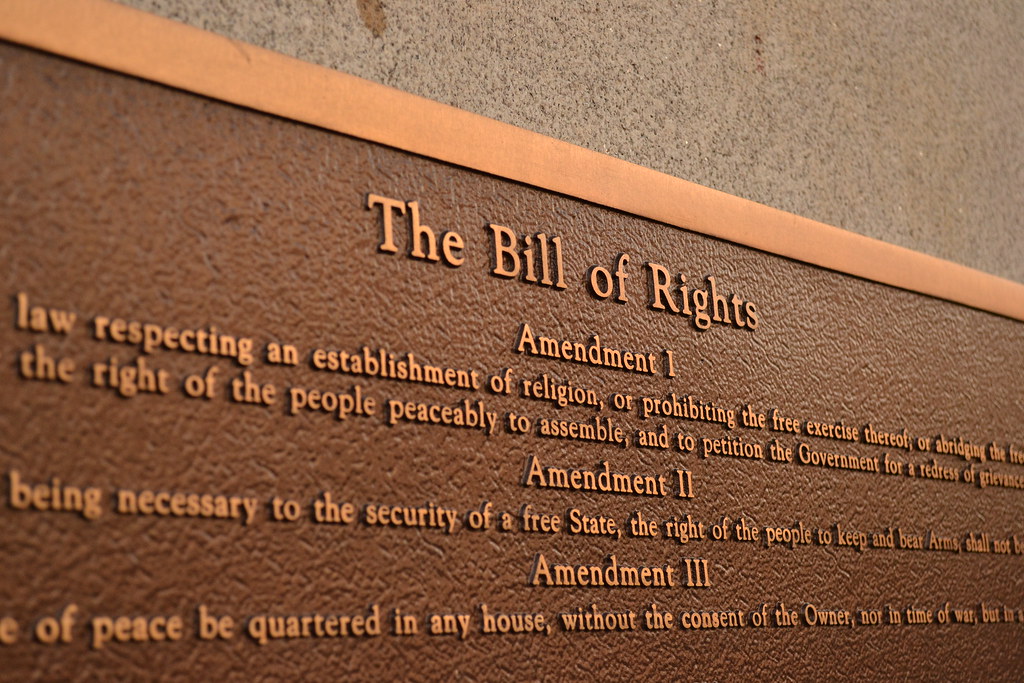
The First Amendment secures the 5 freedoms of Religion, Speech, Press, Assembly and Petition.  These freedoms were seen as essential to maintain a government that is responsible to the people.  It reads:
Congress shall make no law respecting an establishment of religion, or prohibiting the free exercise thereof; or abridging the freedom of speech, or of the press; or the right of the people peaceably to assemble, and to petition the government for a redress of grievances.

Having fought a war using largely armed citizenry, the founding fathers understood the need for the people to be armed against a tyrannical government. The second amendment was to insure people had the means to defend and fight for their rights, it reads:
A well regulated militia, being necessary to the security of a free state, the right of the people to keep and bear arms, shall not be infringed.

The British had often taken over private residences to board their troops, often forcing families to leave their homes or crowed into single rooms.  To insure that this would never happen again the third amendment reads:
No soldier shall, in time of peace be quartered in any house, without the consent of the owner, nor in time of war, but in a manner to be prescribed by law.

The next amendment was meant to insure that our right to privacy from an intrusive government is protexted. The fourth Amendment reads:
The right of the people to be secure in their persons, houses, papers, and effects, against unreasonable searches and seizures, shall not be violated, and no warrants shall issue, but upon probable cause, supported by oath or affirmation, and particularly describing the place to be searched, and the persons or things to be seized.

Governments have long had a habit of holding people they saw as a problem but who hand't committed any crime.  They could be arrested at the whim of the government and had little recourse to get out.  The fifth amendment is meant to make sure that anyone who is arrested is actually charged with a crime by a jury made up of people in the community.  It also protects against being forced to testify against yourself.  It Reads:
No person shall be held to answer for a capital, or otherwise infamous crime, unless on a presentment or indictment of a grand jury, except in cases arising in the land or naval forces, or in the militia, when in actual service in time of war or public danger; nor shall any person be subject for the same offense to be twice put in jeopardy of life or limb; nor shall be compelled in any criminal case to be a witness against himself, nor be deprived of life, liberty, or property, without due process of law; nor shall private property be taken for public use, without just compensation.

Once you are charged with a crime, you still had rights.  You are innocent until proven guilty, and that needs to be in a fair and impartial trial.  To that end the sixth amendment is known as the rights of the accused.  If reads:
In all criminal prosecutions, the accused shall enjoy the right to a speedy and public trial, by an impartial jury of the state and district wherein the crime shall have been committed, which district shall have been previously ascertained by law, and to be informed of the nature and cause of the accusation; to be confronted with the witnesses against him; to have compulsory process for obtaining witnesses in his favor, and to have the assistance of counsel for his defense.

To insure fair civil trial for all the seventh amendments allow for a jury of your peers to hear a dispute between any two parties.  It Reads:
In suits at common law, where the value in controversy shall exceed twenty dollars, the right of trial by jury shall be preserved, and no fact tried by a jury, shall be otherwise reexamined in any court of the United States, than according to the rules of the common law.

To insure no one is deprived of their liberty, one of the 3 rights listed in the declaration of independence, the eight amendment insures that a fair bail for those accused of a crime, and a fair punishment for those convicted of a crime.  It Reads:
Excessive bail shall not be required, nor excessive fines imposed, nor cruel and unusual punishments inflicted.

The writers of the Constitution were concerned that by listing certain right, it might be assumed that any right they did not list by name was not a right the people had.  The ninth amendment was meant to address this concern.  It states that just because a right is not listed in the Bill of Rights doesn't mean it does not exist and the government must respect all the rights of the citizen listed or not.  It reads;
The enumeration in the Constitution, of certain rights, shall not be construed to deny or disparage others retained by the people.

The last Amendments in the Bill of Right deals with the principle of Federalism.  It states that the Constitution gives certain powers to the National government, and limits certain powers to the states.  Any power not listed in the Constitution are by default State Powers.  It Reads:
The powers not delegated to the United States by the Constitution, nor prohibited by it to the states, are reserved to the states respectively, or to the people.

Tuesday, September 18, 2018

Principles of the American System of Government.


The foundation of American Governance is rooted in the Enlightenment Ideals of the Founding Fathers as expressed in the Declaration of Independence and the Constitution of the United States.
These Ideals are summed up in The Declaration of Independence when it says:

"We hold these Truths to be self-evident, that all Men are created equal, that they are endowed by their Creator with certain unalienable Rights, that among these are Life, Liberty and the Pursuit of Happiness--That to secure these Rights, Governments are instituted among Men, deriving their just Powers from the Consent of the Governed."

In this one sentence we see the principles of Popular Sovereignty,  Republicanism, and Individual Rights.That Governments exist to serve the people of the state, they gain power only through the consent of those they hope to govern.  To protect these basic ideals the founding fathers instituted other ideals including federalism, separation of powers, checks and balances, and limited government through the US Constitution.

Federalism is the ideal that the National Government should have limited powers and should share responsibility for governing with the state and local governments.  By limiting the power of the National government the founding fathers hoped to keep more of the decisions at the level where the people most effected had the most influence.

At the National level the government is separated into 3 equal branches.  Each branch is responsible for a different function of government. By separating the power of the government in to 3 branches the founding fathers hoped to keep any one group from gaining too much power and acting outside the will of the people.  To that end the 3 branches also serve as a check on each.  The Legislative Branch (Congress) to write the laws (their Power) and control the purse (Allocating Money, check on the Executive Branch) and approve the appointment of Judges (Check on the Judicial Branch).  The Executive Branch (The President) approves and enforces the legislation and rules set out by the Legislative Branch (Check on the Legislative) , spends the money allocated by the legislative branch and appoints Judges (Check on the Judicial Branch).  The Third branch is the Judicial Branch consisting of the Supreme Court and lower federal courts.  The job of the Judicial Branch is to rule the enforcement of the law (Check on the Executive) as well as the constitutionality of the law (Check on the Legislative).

The last Ideal is one of limited government.  The Government ONLY had the power specifically given to it.  The Government is supposed to act only within the guidelines laid out by the Constitution.

Monday, September 17, 2018

Happy Constitution Day!!!!


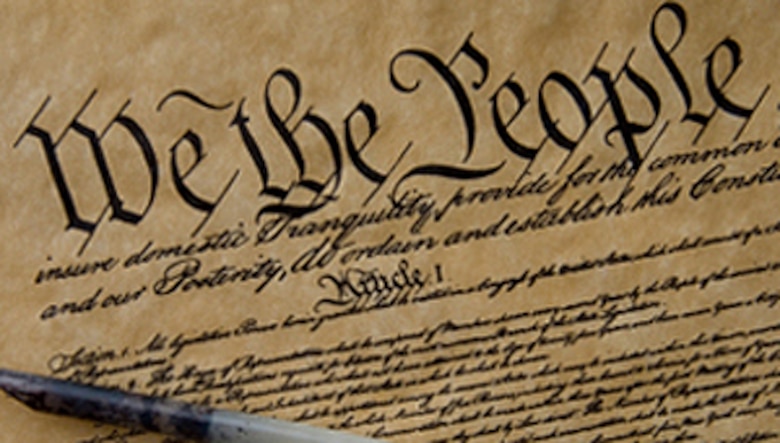
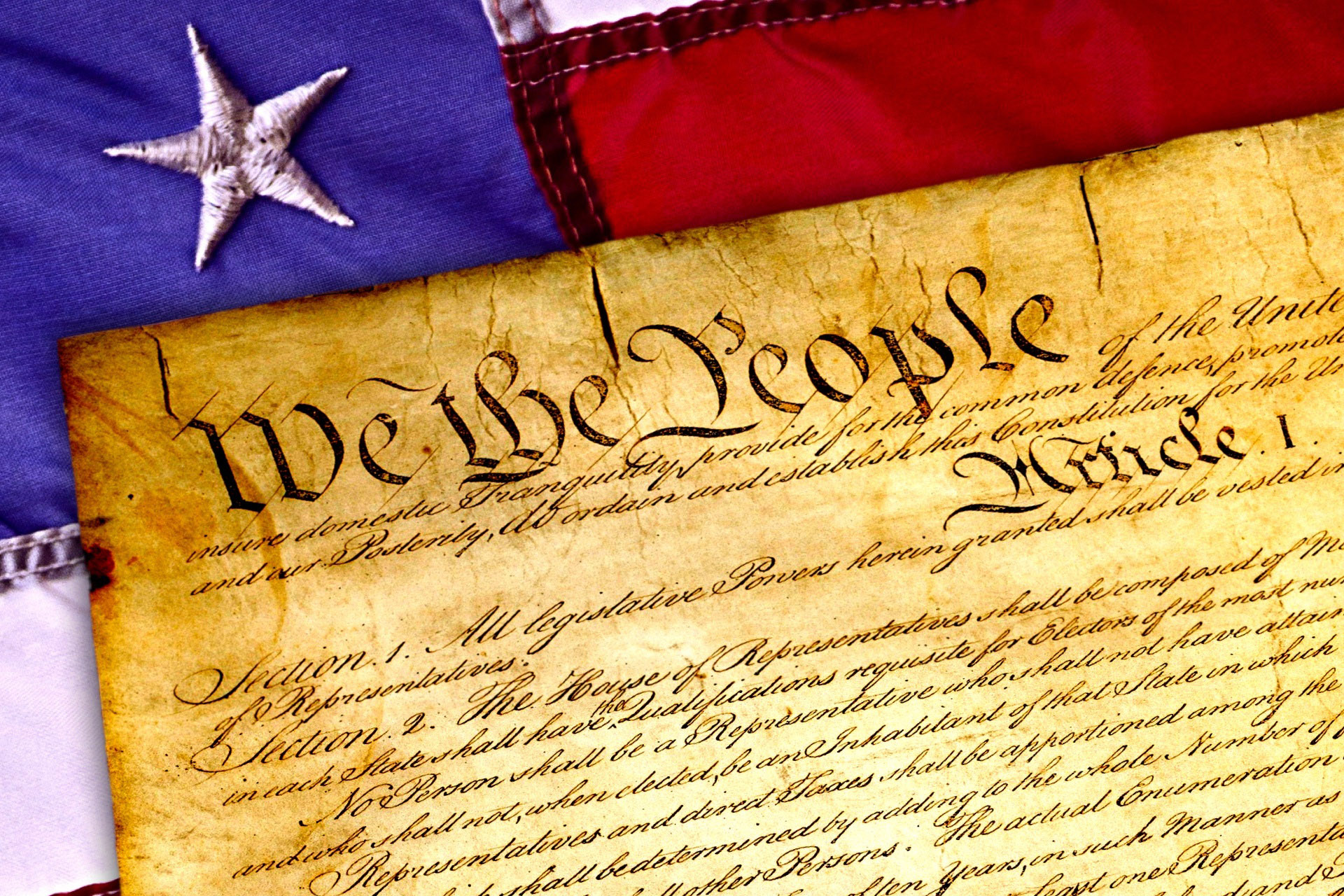
On Monday September 17th 1787, 39 members of the Constitutional Convention completed their work and signed their names to the  document that would become the Constitution of the United States of America.  This document would become the basis of the of a new government for the United States of America.  The first 3 words of the US Constitution are "We the People".  They are larger than the rest of the text and seem to jump off the page, this was to drive home the fact that the new government existed to serve the people of the United States and not the other way around.  The US Constitution is the oldest single founding document for any democracy in the world today. 

Sunday, September 16, 2018

Celebrate Freedom Week September 16th - 22nd


On September 17th, 1787 the representatives from the 13 colonies gathered to sign the document that would become the United States Constitution.  This day is recognized nationally as Constitution day, and the week of the 17th is Celebrate Freedom Week.  This week will include topics concerning the intent, meaning, and importance of the Declaration of Independence and the U.S. Constitution.  The study of the Declaration of Independence will include its relationship and influence in the creation of the American ideals in creating a united nation our of a diverse peoples.  Students in Grades 3 - 12 will study and recite the preamble of the Declaration of Independence, learn about the principles of the constitution, and the foundations of our democracy.

Saturday, September 15, 2018

Texian Navy Day!


The Texas Legislature has designated the third Saturday in September, as Texian Navy Day to commemorate and remember the service of those who served in the Texas Navy.

In 1835, with war looming between The Republic of Texas and Mexico, the General Council of the provisional government of Texas passed a bill to purchase 4 ships and create the first Texas Navy.  In January of 1836 The Republic of Texas took possession of the Liberty, the Invincible, the Independence, and the Brutus.  The First commodore of the Texas Navy was Capt. Charles E. Hawkins.  These ships were tasked with protecting the vital ports in Galveston, Matagorda Bay and the mouth of the Brazos River from attack.  This first Texas Navy served a little more than a year before all the ships were lost.  A second Texas Navy would be formed in 1839 and serve until the Republic of Texas was annexed into the United States and the navy was transferred into the United States Navy.

In 1958 Governor Price Daniel established the Third Texas Navy as a patriotic organization and an arm of the civil defense of the great State of Texas.

Texas State Historical Association - Texas Navy
Daughters of the Republic of Texas- Texian Navy Day
Texas Navy Association

Tuesday, September 11, 2018

Texas First Responders Day

On September 11th Texas Celebrates the bravery, courage and determination of our EMS, Fire and Police Departments.  These men and women put work nights, weekends and holidays to insure that we are safe. The state of Texas has designated September 11th as Texas First Responders Day.

Thursday, September 6, 2018

YMCA Youth and Government comes to Boerne

The Boerne YMCA is organizing a Legislative Delegation for the YMCA Youth and Government Program.  This program is open to any high school aged students in the Boerne Area including home schooled students.  You do not have to be a member of the Boerne YMCA in order to your students to participate.  The information from the Boerne YMCA is listed below:


Join Boerne's 1st Youth and Government Delegation
Who: Open to all high school students
What: All interested in participating in the legislative process: discuss issues, bill writing, debating, presenting, and getting your voice heard!

Weekly meetings from September 6 through February
When: Thursdays from 5:45 - 6:45 pm
Where: Boerne Family Y

Conference Dates
When: District - November 10 and 17, State - January 24-27
Where: Austin

Why: Democracy must be learned by each generation

How to find out more information: Attend a meeting or call the Y for details!
How to join: Attend a meeting by Oct 18