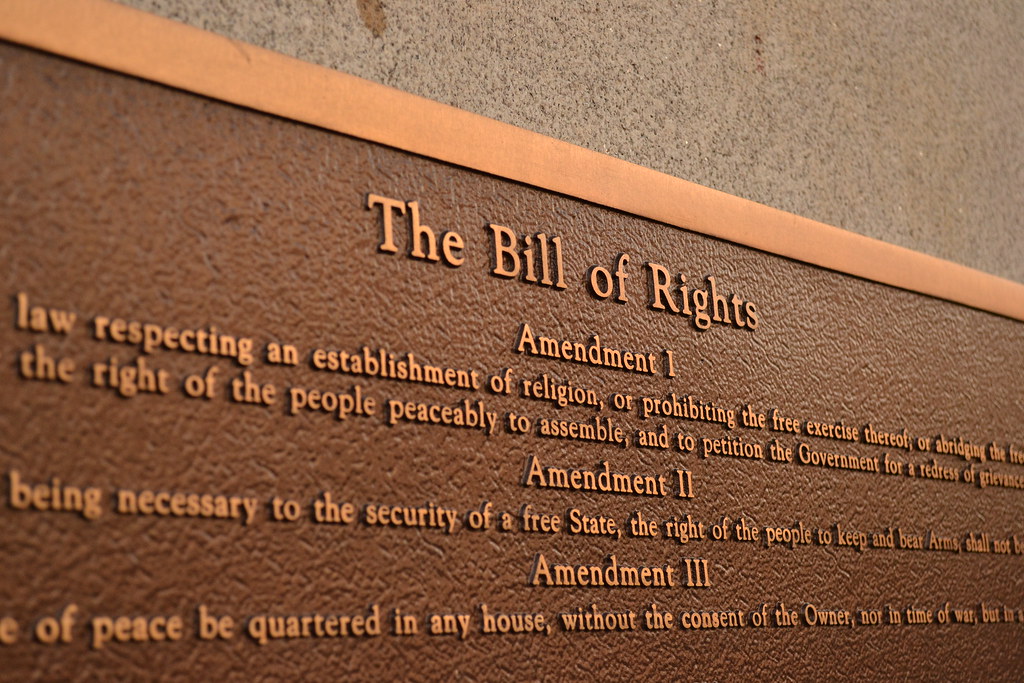
In the fight to ratify the Constitution of the United States, the largest overriding concern was with the protection of individual rights. The people of the 13 colonies had just fought a long and hard war to secure their freedoms and rights, and were in no hurry to create a strong national government that could take those rights away. In order to secure the passage of the Constitution 10 Amendments were proposed and eventually added. These Amendments are known as the Bill of Rights
The First Amendment secures the 5 freedoms of Religion, Speech, Press, Assembly and Petition. These freedoms were seen as essential to maintain a government that is responsible to the people. It reads:
Congress shall make no law respecting an establishment of religion, or prohibiting the free exercise thereof; or abridging the freedom of speech, or of the press; or the right of the people peaceably to assemble, and to petition the government for a redress of grievances.
Having fought a war using largely armed citizenry, the founding fathers understood the need for the people to be armed against a tyrannical government. The second amendment was to insure people had the means to defend and fight for their rights, it reads:
A well regulated militia, being necessary to the security of a free state, the right of the people to keep and bear arms, shall not be infringed.
The British had often taken over private residences to board their troops, often forcing families to leave their homes or crowed into single rooms. To insure that this would never happen again the third amendment reads:
No soldier shall, in time of peace be quartered in any house, without the consent of the owner, nor in time of war, but in a manner to be prescribed by law.
The next amendment was meant to insure that our right to privacy from an intrusive government is protexted. The fourth Amendment reads:
The right of the people to be secure in their persons, houses, papers, and effects, against unreasonable searches and seizures, shall not be violated, and no warrants shall issue, but upon probable cause, supported by oath or affirmation, and particularly describing the place to be searched, and the persons or things to be seized.
Governments have long had a habit of holding people they saw as a problem but who hand't committed any crime. They could be arrested at the whim of the government and had little recourse to get out. The fifth amendment is meant to make sure that anyone who is arrested is actually charged with a crime by a jury made up of people in the community. It also protects against being forced to testify against yourself. It Reads:
No person shall be held to answer for a capital, or otherwise infamous crime, unless on a presentment or indictment of a grand jury, except in cases arising in the land or naval forces, or in the militia, when in actual service in time of war or public danger; nor shall any person be subject for the same offense to be twice put in jeopardy of life or limb; nor shall be compelled in any criminal case to be a witness against himself, nor be deprived of life, liberty, or property, without due process of law; nor shall private property be taken for public use, without just compensation.
Once you are charged with a crime, you still had rights. You are innocent until proven guilty, and that needs to be in a fair and impartial trial. To that end the sixth amendment is known as the rights of the accused. If reads:
In all criminal prosecutions, the accused shall enjoy the right to a speedy and public trial, by an impartial jury of the state and district wherein the crime shall have been committed, which district shall have been previously ascertained by law, and to be informed of the nature and cause of the accusation; to be confronted with the witnesses against him; to have compulsory process for obtaining witnesses in his favor, and to have the assistance of counsel for his defense.
To insure fair civil trial for all the seventh amendments allow for a jury of your peers to hear a dispute between any two parties. It Reads:
In suits at common law, where the value in controversy shall exceed twenty dollars, the right of trial by jury shall be preserved, and no fact tried by a jury, shall be otherwise reexamined in any court of the United States, than according to the rules of the common law.
To insure no one is deprived of their liberty, one of the 3 rights listed in the declaration of independence, the eight amendment insures that a fair bail for those accused of a crime, and a fair punishment for those convicted of a crime. It Reads:
Excessive bail shall not be required, nor excessive fines imposed, nor cruel and unusual punishments inflicted.
The writers of the Constitution were concerned that by listing certain right, it might be assumed that any right they did not list by name was not a right the people had. The ninth amendment was meant to address this concern. It states that just because a right is not listed in the Bill of Rights doesn't mean it does not exist and the government must respect all the rights of the citizen listed or not. It reads;
The enumeration in the Constitution, of certain rights, shall not be construed to deny or disparage others retained by the people.
The last Amendments in the Bill of Right deals with the principle of Federalism. It states that the Constitution gives certain powers to the National government, and limits certain powers to the states. Any power not listed in the Constitution are by default State Powers. It Reads:
The powers not delegated to the United States by the Constitution, nor prohibited by it to the states, are reserved to the states respectively, or to the people.

No comments:
Post a Comment